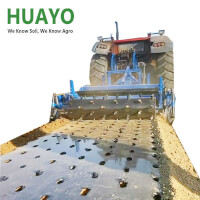
The Rotary Ridger with Film Cover Hole Puncher is a farm implement that prepares land by combining multiple tasks, including rotary tillage, ridging, fertilization, and plastic film covering, while simultaneously punching holes in the plastic film. It is powered by a tractor and works by creating ridges, laying down a plastic film, and creating holes in the film for planting, all in a single pass. It can save time and labour for seeds planting , like garlic, vegetables.
The following is an introduction:
- Function integration: It can perform rotary tillage to loosen the soil first, making it suitable for subsequent planting operations. Then, it carries out ridging work to form the ridges and furrows required for planting. During this process, it can also fertilize, spreading fertilizers into the soil according to a certain amount and depth. Finally, it can cover the plastic film on the ridges and punch holes in the plastic film at the same time, which provides conditions for the subsequent planting of crops such as garlic and vegetables, reducing the need for manual secondary operations.
- Working power and efficiency: This machine is powered by a tractor, which uses the power output shaft of the tractor to drive the operation of each working part. It can complete multiple processes in one pass, which greatly saves labor costs and time compared with traditional single – function agricultural tools, and is beneficial to improving the timeliness of planting and the scale of agricultural production.
- Scope of application: It is mainly used for the pre – sowing land preparation of crops suitable for plastic – film – covered cultivation, such as root vegetables like garlic, and various leafy vegetables and solanaceous vegetables.
The ridges formed after rotary tillage, ridging and compaction are mainly used to create a better soil environment and planting conditions for crop growth, meeting various field management needs.
- After ridging, the soil is in a raised state with a looser structure and significantly improved air permeability. This provides sufficient oxygen for crop roots and reduces the risk of root suffocation.
- The compaction step prevents the soil from being too loose, increases the contact area between the soil and roots, helps roots fix better and absorb nutrients, and avoids ridge collapse caused by later watering or rain.
- The height difference between the raised ridge surface and the furrows between ridges allows rainwater to flow into the furrows and drain quickly during the rainy season. This effectively reduces water accumulation at the crop roots and minimizes waterlogging damage.
- During droughts, the ridge soil has better water retention capacity. When irrigating, water can seep along the furrows, avoiding direct scouring of crop roots and reducing water evaporation waste.
- For root and tuber crops (such as potatoes, sweet potatoes, and garlic), the raised ridges provide a deeper soil layer, which facilitates the expansion and growth of underground tubers and reduces skin damage.
- Some cash crops (such as strawberries and peppers) are planted in ridges, which can increase the surface temperature (the ridge surface has a larger light-receiving area), advance the crop growth period, and facilitate later harvesting and pest control.
- The furrows between ridges can be used as field operation channels, making it convenient for manual or mechanical operations such as fertilization, weeding, and pesticide spraying, and reducing trampling damage to crops.
- After ridging, soil fertility is more likely to concentrate in the plough layer of the ridge surface, which improves fertilizer utilization and reduces nutrient competition between weeds and crops.
Hydraulic folding all-in-one tillage, ridge-making, mulching and hole-punching machine for garlic and onion planting.


It rotate and cultivate the soil properlly, cover mulch film and punch holes with demand space.
What’s more, it can dig holes uniformly with same row spacing and hole spacing.
The planting bed will Increase soil porosity, increase field water holding capacity by 12%, and reduce wilting coefficient by 13%. This technology realizes deep fertilization, greatly improves soil fertility and the effective utilization of nutrients by crops, and will have a great impact on increasing crop production in arid areas .
According to planting pattern, it can add Plastic Film Mulch Layer, Irrigation drip tape Layer and Fertilizer in one.
When People transplant Vegetable Seedlings manually, the Bed Maker Plastic Film Layer can add Hole Puncher dig holes on the plastic mulch with uniform holes. The Vegetable Seedling can be transplanted to each holes with same row Spacing and Plant Spacing. You can also plant seeds to the holes directly.
With hole punched, you can also transplant Onion Seedling.

Combined Fertlizer Rotary Cultivator, Drip tape layer, Platic film cover for seeds planting preparing.
Two Ridge Rotary Ridger Bed Maker with presser
Rotary Ridger Film Cover and Seeds Planter
1.5m Bed Maker for seed planting
HYZO-6 Onion Transplanter
HGBS-3 Garlic Seed Splitting and Sorting Machine



Leave A Comment
You must be logged in to post a comment.